

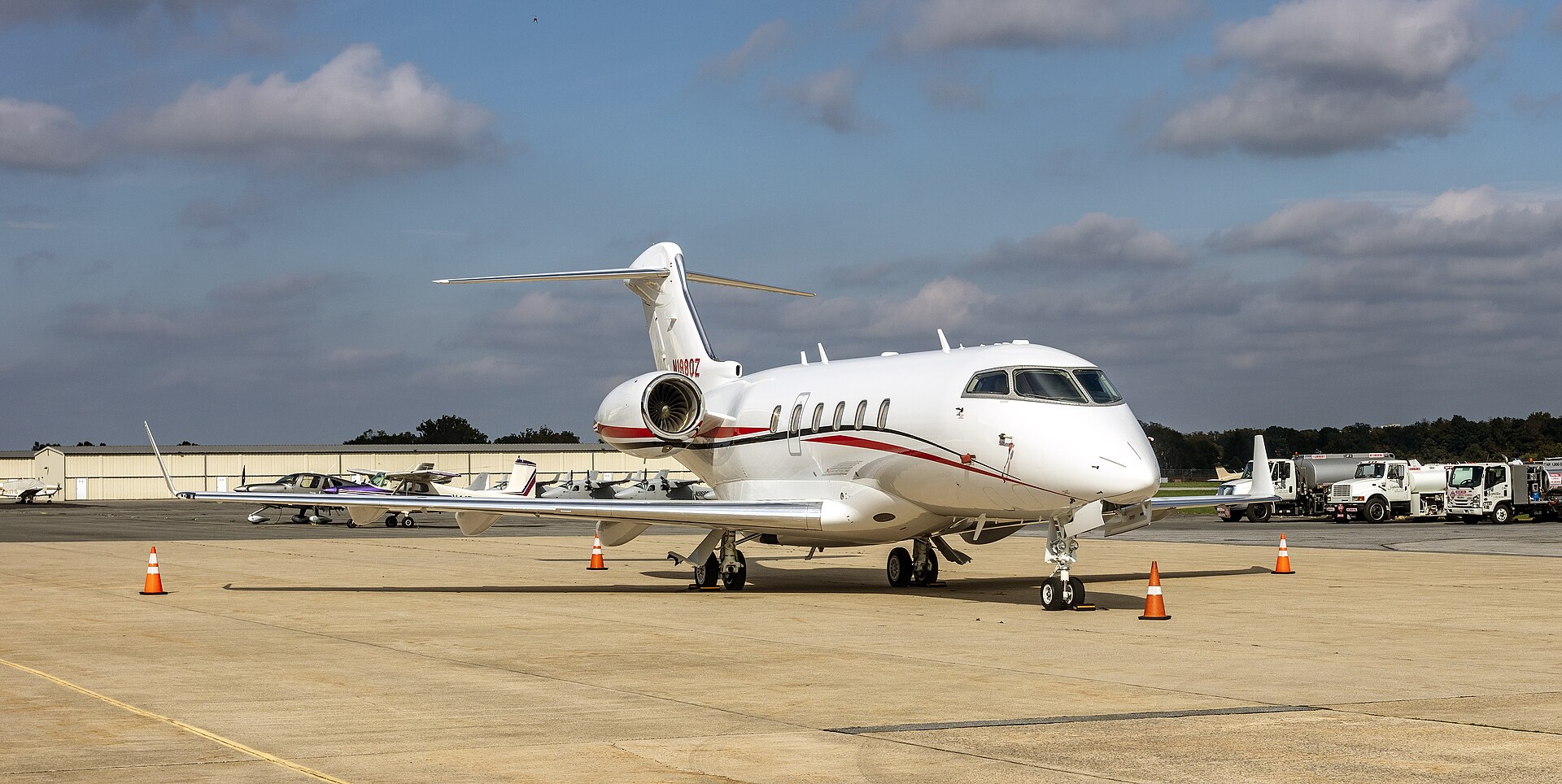
If you are planning a midsize jet charter from Singapore, the decision that matters most is not the brand of aircraft but whether a standard midsize cabin covers your sector length, group size and luggage. This guide compares the two aircraft that most often sit at the top of that choice for regional Asia trips, the Bombardier Challenger 350 and the Embraer Praetor 600, and explains where each one earns its place.
Athena Jets is a Singapore-based brokerage, so what follows is about how to specify and buy the flight. We do not operate aircraft, and every figure below comes from published manufacturer-style data or market rate guides, which are indicative rather than quotes.
Is a midsize jet charter enough for regional Asia trips?
The honest answer depends on the sector. Published figures put a midsize jet at roughly 2,405 to 3,340 nautical miles of range, while a super midsize stretches to about 3,125 to 4,018 nautical miles, with the two classes overlapping in the 3,125 to 3,340 nm band. One practical rule of thumb from the same analysis is to stay with midsize when the flight is under roughly 3,100 nm, the group is four to six people and luggage is ordinary carry-on weight. Move up when the group wants a stand-up cabin for the whole flight or the sector approaches 3,300 nm.
It also helps to know that "super midsize" is a marketing category rather than a regulatory one. Neither ICAO, the FAA nor EASA defines it, so the label on a broker's listing tells you little until you check the cabin dimensions and runway performance yourself.
Cabin width, length and runway needs
Cabin height barely separates the two classes on manufacturer data, which is why brochures lead with other numbers. Width is the difference you notice. Cabin width runs at about 1.96 m on a midsize, against roughly 2.11 to 2.19 m on the super midsize models compared, and the extra length is what makes a four-hour sector comfortable for eight passengers.
The trade-off is runway. A super midsize typically needs about 150 to 380 metres more takeoff distance, which can close short or high-elevation airfields that a midsize can still use at maximum weight. For Singapore departures this rarely matters, but it does matter if your itinerary includes a smaller island strip or a hot, high airport in the region. Ask your operator for the takeoff distance at your planned weight before you commit.
Challenger 350 charter: the wide-cabin workhorse
Range and seating on the Challenger 350
The Challenger 350 is the aircraft most operators put forward when a client asks for a super midsize at a sensible price. Published range figures vary by source. One manufacturer-derived summary gives a normal range of 3,300 nm and a maximum of 3,200 nm, while another cites 3,689 nm for the same type, so treat any single number as a starting point and confirm the payload-range trade-off for your passenger count.
Typical seating is eight in a double-club layout, with nine possible when a three-seat divan replaces two club seats. Cabin volume is quoted at around 930 cubic feet, which is why the type feels roomier than its size suggests. Check the endurance figure as well as the range when your route involves a headwind or a diversion.
Who the Challenger 350 suits
Choose it for groups of six to eight who want a flat floor, a stand-up aisle and a lavatory, and who fly mostly 4 to 6 hour sectors. Note that the newer Challenger 3500 variant is widely listed under the same family, so when you request a quote, specify the exact serial variant and cabin configuration the operator intends to use.
Praetor 600 charter: when range and cabin extras matter
Praetor 600 range and cabin
The Praetor 600 is the choice when the sector is long or when the cabin needs to double as a working space. Published range is 4,018 nm under NBAA IFR conditions with four passengers, and the type is typically configured for eight passengers, with a nine-seat option using a divan. Its cabin includes fully reclining club seats that can be berthed into beds, and the baggage space is among the largest in its class.
Sources disagree on cabin volume. One overview quotes 840 cubic feet, while another gives 1,100 cubic feet, so ask the operator for the interior layout drawing rather than relying on the headline number. The Praetor is also one of the few in this class where the operator may offer built-in connectivity, including Starlink on newer examples, which is useful for executives who need to stay online through a long leg.
Praetor 600 versus Challenger 350 on the same trip
On paper the Praetor gives roughly 800 nm more range than the Challenger 350, but that gap is only valuable if the route needs it. For most short-haul regional sectors out of Singapore, the cheaper Challenger or a midsize is the better fit. The Praetor earns its premium when you want a nonstop run that avoids a technical stop, or when you carry more luggage on a longer loop.
Indicative hourly rates for midsize and super midsize charter
Pricing is the area where sources diverge most, and most published guides are US-centric. Treat the figures below as indicative bands, not Asian quotes. Positioning, fuel, fees and taxes are typically added on top of the hourly rate.
- Midsize jets: one market guide puts charter at about $4,000 to $6,500 per flight hour in 2026, while a second broker lists $8,300 to $10,144 for a midsize with a shorter published range.
- Super midsize jets: the same guide gives $5,500 to $9,000 per flight hour, and the premium over a midsize is commonly estimated at $1,000 to $2,500 more per flight hour.
- Super midsize, premium end: another analysis places the super midsize at roughly $10,000 to $14,600 an hour before positioning and fees.
As an illustration only, a three-hour sector at the quoted midsize band would cost in the region of $12,000 to $19,500 before positioning, while the same sector on a super midsize at the quoted band would cost roughly $16,500 to $27,000. The spread reflects aircraft age, operator, seasonality and how far the aircraft must reposition to reach you. Ask for a fixed-price quote that itemises the positioning leg.
Routing from Singapore: Seletar, Changi and handling rules
For most light-to-midsize charters from Singapore, Seletar (WSSL) is the airport to request. Business aviation traffic is funnelled through the business aviation centre at Seletar, and every non-scheduled flight is handled there. It sits roughly 20 km from Changi and about 17 km from the city centre, and ground handling at Seletar is generally priced below Changi. Changi remains an option for larger aircraft or for connections with commercial flights, but expect higher handling costs and more ground delays.
Plan your timing around Seletar's hours. The airport runs daily from 0700 to 2200 local time, with a night curfew from 2200 to 0700 except for medical or emergency flights, and weekend or holiday movements can attract overtime charges. Every private or chartered jet flying into Seletar must also use a licensed ground handling agent, so check which handler your operator has booked. If your trip is a regional leisure run, our Singapore to Bali guide covers airport and routing choices for that sector, and the Singapore to Tokyo guide covers the longer North Asia legs where range becomes the deciding factor.
Questions to put to an operator before you book
- Which exact variant and cabin layout will fly my trip, and can you send the interior drawing?
- What is the payload-range figure for my passenger count and luggage, not the headline maximum range?
- What is the takeoff distance at my planned weight, and does it work at my departure airport?
- Is the quote all-in, or does it exclude positioning, handling, overflight and fuel uplift?
- Which ground handler is assigned at Seletar or my destination, and what are the overtime rules?
- What is the minimum crew rest and duty plan if my return leg is the same day?
How to bring the cost down
The cheapest seat on a midsize is often an empty leg, where an aircraft is already flying to collect its next passenger. Empty legs come with fixed departure times and limited availability, so keep your dates flexible and check the live board regularly through our live empty legs page. If you fly several times a year, compare a jet card against ad hoc charter using the jet card rates we publish, because a prepaid block can lock in an hourly rate for the cabin you prefer. To see an indicative total for your own route, the private jet cost calculator gives an instant estimate.
Our 24/7 desk can check the sector, airport and aircraft options for your trip and return a written quote. Call +65 9366 4327 or write to charter@athenajets.com, or use the request a quote form if you want to start online.
Frequently asked questions
What is the difference between a midsize and a super midsize jet?
A super midsize jet generally offers more range, roughly 3,100 to 4,000 nautical miles compared with about 2,400 to 3,300 for a midsize, and a wider, longer cabin. The trade-off is that it needs more runway, typically 150 to 380 metres more takeoff distance, and it costs more per hour. Neither class has a regulatory definition, so check the specifications for each aircraft.
How much does a midsize jet charter cost per hour?
Market guides put midsize charter at roughly $4,000 to $6,500 per flight hour in 2026, and super midsize at about $5,500 to $9,000. Other brokers quote higher bands. These are indicative figures based on US-centric data, and positioning, fuel, fees and taxes are usually added. Request an all-in quote for your specific Asian sector.
Does the Praetor 600 have more range than the Challenger 350?
Yes, on published figures. The Praetor 600 is listed at about 4,018 nautical miles, while the Challenger 350 is commonly listed at about 3,200 nautical miles, although some sources quote a higher figure for the Challenger. Real range depends on passenger load, baggage, winds and altitude, so ask the operator for a payload-range calculation before you choose.
Which airport should a private jet use in Singapore?
Seletar Airport (WSSL) is the usual choice for private and chartered jets, because all non-scheduled flights are handled at the business aviation centre at Seletar. It is generally cheaper to handle than Changi. Seletar operates daily from 0700 to 2200 local time with a night curfew, so confirm slot timing and any weekend overtime with your handler before booking.