

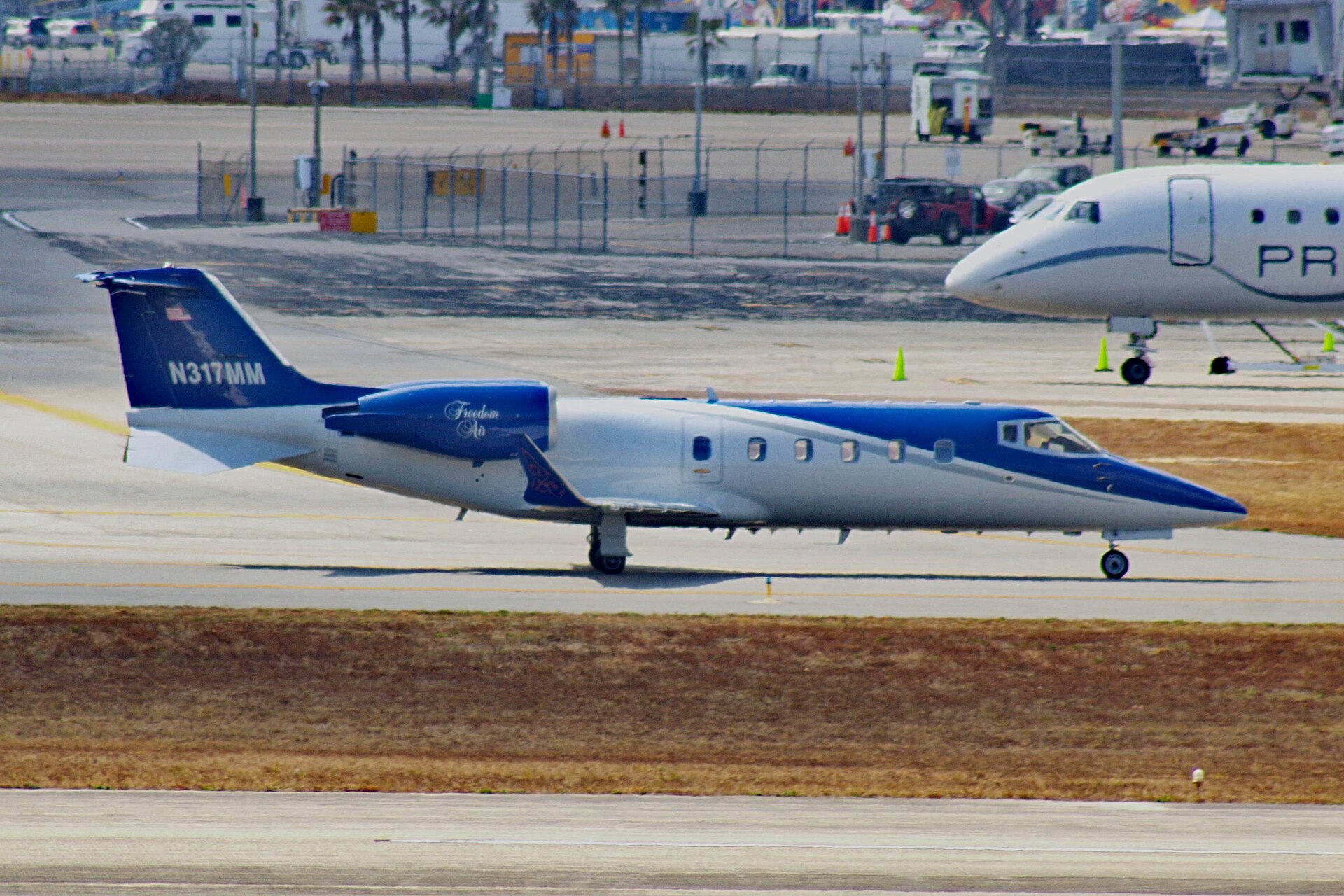
A Learjet 60 crash in Palm Beach County, Florida, on 1 November 2026 killed all nine people on board, and the investigation is still in its early stages. For anyone considering private jet charter from Singapore, the accident is a useful prompt to look harder at the operator, the crew and the weather plan rather than only the aircraft type or the hourly rate.
What happened on 1 November
According to the Federal Aviation Administration, the aircraft came down near West Palm Beach at about 17:49 UTC (12:49 local time) with nine people on board. The flight had departed Austin-Bergstrom International Airport (AUS) for North Eleuthera Airport in the Bahamas. The NTSB has identified the aircraft's operator, and naming an operator is a routine step in an NTSB probe that does not, on its own, point to fault.
The crash site was residential. Around 600 people were moved out of a nearby mobile home community while the wreckage was processed. Palm Beach County authorities carried out the evacuation while federal officials investigated the crash.
What investigators have and have not established
The crew's last radio calls are the centre of the inquiry. According to the NTSB, the crew first reported light clear ice and moderate turbulence at 35,000 feet, then asked for and received clearance to climb to 37,000 feet. Less than half a minute later the aircraft reported it was descending, followed by a mayday call, and a further transmission described an overspeed condition.
The more concerning physical evidence is that the jet may have been coming apart in the air. An NTSB board member said debris could lie some distance from the impact zone. Evidence at the crash site indicated the aircraft started to break up in the air. He also noted that once a structure fails in this way, control is effectively lost.
Recovery is proving difficult. Water has collected in the crater, which complicates access to the wreckage. It is also unclear whether the cockpit voice recorder survived, since the aircraft was originally fitted with one, and the NTSB is working to establish whether it was still on board and, if so, to locate it.
The cause has not been determined, and the NTSB has been careful not to speculate. The agency expects to publish a preliminary report within 30 days, while a final report with probable cause could take one to two years. Investigators are also examining crew qualifications, including the co-pilot's limitations as pilot-in-command.
Why icing and breakup matter to charter buyers
Icing at altitude is a known hazard for business jets, and the question is whether it was managed. An aviation attorney quoted in the coverage said investigators could look at whether an issue involving the aircraft's de-icing system played a role, and that uncontrolled icing can lead to a stall. He also pointed to the aircraft's autopilot system as another area investigators may examine. These are hypotheses from outside the investigation, not findings, and readers should treat them that way.
For a charter client, the practical lesson is that the cabin and the brand matter less than how an operator handles weather at cruise levels, how it trains crews for turbulence and ice, and how it maintains ice protection. Those are questions an operator can answer in writing before you pay a deposit.
What this means for private jet charter in Asia
No regulator has linked this accident to any Asian operator, and the NTSB's work is specific to a US aircraft and a US operator. Athena's view is that the event should lead to sharper buying questions, not a blanket rejection of business aviation. Singapore-based clients often fly long sectors over water and into variable winter weather, so the same checks apply whether the trip is to Tokyo, Seoul or Beijing.
Weather routing deserves specific attention. Tropical Southeast Asian sectors generally carry less icing exposure than northern routes in the cooler months, so a winter trip to Tokyo from Singapore or a ski-season run to Hokkaido warrants a more detailed weather plan than a short hop to Bangkok. Ask the operator to brief the forecast icing levels along the planned altitudes, not just the destination weather.
Questions to put to an operator before you book
- Which authority certifies the operator, and can it supply a copy of its operating certificate and current operations specifications?
- How does the crew plan for icing and turbulence at cruise altitude, and what is the company's rule for climbs requested in weather?
- What is the ice protection fit on the specific tail number you will fly, and when was it last inspected?
- Who is pilot-in-command on your sector, and what are the crew's recent hours on the type?
- What is the operator's policy if a forecast deteriorates during the flight, including diversion planning?
The answers matter more than a brochure. A reputable operator should be able to respond to each point in plain terms without deflecting.
Does the crash change how you should book empty legs?
Empty legs remain a sensible way to lower cost, but they are repositioning flights, and the same operator checks apply. Do not choose an operator on price alone. Review the operator's answers first, then decide whether the saving is worth the flexibility trade-off. You can browse current empty leg options, use our private jet cost calculator to compare the budget against a full charter, and then check the operator's details before confirming.
Market context: demand for jets is still strong
The crash comes at a time when manufacturers report strong order books. General Dynamics' aerospace division, which builds Gulfstream jets, reported 40 deliveries in the quarter, made up of five super-midsize G280s and 35 large-cabin models, and 119 aircraft across the first nine months, including 18 G280s and 101 large cabins. The backlog stood at nearly $25.4 billion. Strong delivery numbers mean more aircraft in service, which can tighten availability on popular dates. Booking earlier for year-end and Lunar New Year travel is a sensible response, whatever the accident outcome.
For more route-level guidance and fleet notes, see our journal, or request a quote with your dates, passenger count and preferred departure airport so the operator's safety answers can be compared like for like.
Our 24/7 desk is available on +65 9366 4327 or at charter@athenajets.com if you would like help framing these questions for a specific trip. There is no obligation to book, and we are happy to explain what an operator's answers should look like.
Frequently asked questions
Is private jet charter safe after the Learjet 60 crash in Florida?
The cause of the 1 November crash has not been determined, and the NTSB has not assigned blame. Investigators reported that the aircraft may have broken up before impact. Individual operators differ widely in their safety management, so the sensible response is to verify the operator's certificate, crew training and weather planning before booking, rather than assuming the whole sector is unsafe.
How long will the NTSB take to publish findings on the Learjet crash?
The NTSB expects to release a preliminary report within 30 days of the accident. A final report that sets out probable causes could take one to two years. Interim statements may reveal more about weather, recorders and wreckage in the meantime, but the probable cause will not be fixed until the final report is issued.
What should I ask a charter operator about icing and turbulence?
Ask how the crew plans for icing and turbulence at cruise altitude, what the company's policy is for climbs requested in weather, and what ice protection the specific aircraft carries. Also ask who acts as pilot-in-command on your sector and how recent their hours are on the type. Written answers are a good sign of a disciplined operator.
Is icing a concern for private jet flights from Singapore?
Icing is most relevant at altitude in cold, moist air, so it is generally a bigger planning factor for northern routes in cooler months than for short tropical sectors. For flights from Singapore to Japan, Korea or northern China in winter, ask the operator to brief forecast icing levels along the planned altitudes, not just the destination weather.