

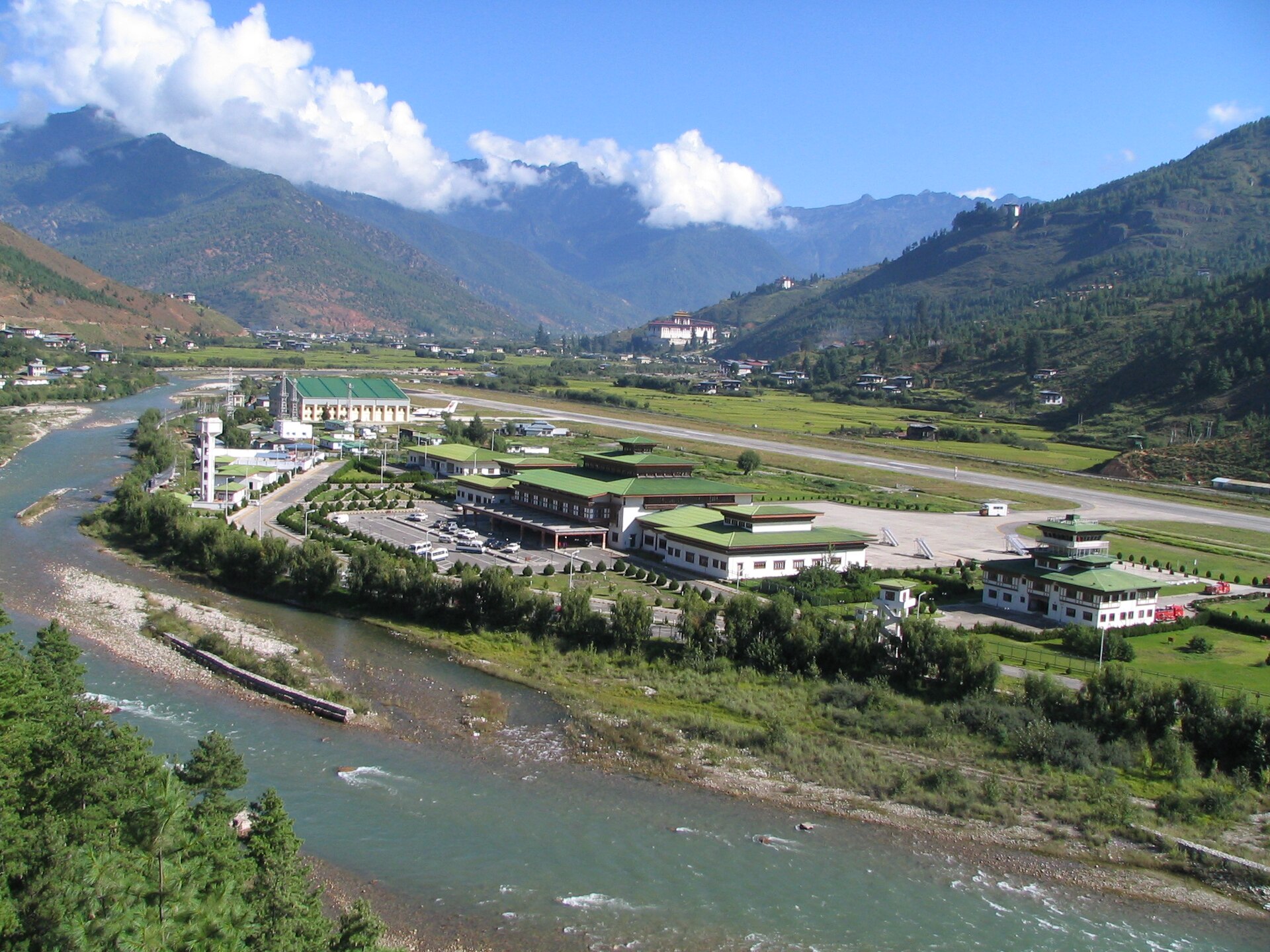
Flying a private jet to Bhutan means landing at one airport, Paro International (PBH), and Paro sets the rules for everything else. It is the sole international airport of the four airports in Bhutan. Operations there depend on clear sight of the terrain and are confined to the daylight window, so the real planning question is whether your aircraft, crew and travel date can meet those limits, rather than whether the jet has the range.
Flying a private jet to Bhutan: the short answer
A private jet can be routed into Paro, but the trip is built around the approach. The valley sits at about 7,332 ft, and the airport is surrounded by mountains as high as 5,500 m (18,000 ft). Expect a shorter operating day than at most international airports, a higher bar for the flight crew, and a few days of weather margin in the itinerary. Charter a private jet for Bhutan only after you have checked those three points with the operator.
Why Paro's approach limits which flights can happen
Visual, manual and daylight only
Paro has no radar and no instrument landing system, so the crew flies the final approach by eye. Pilots fly entirely in manual mode, navigating the winding valley using a series of visual landmarks as checkpoints. The only electronic aid is a single VOR, and pilots must execute a steep turn during the final stages of landing on the narrow runway. The runway itself is hard to pick out early. It is visible only in the final one to two nautical miles of approach, compared to the standard ten or more miles most airports provide. No landings are permitted at night or in low visibility.
Weather minimums and seasonal closures
Visibility is the first gate. Landing at Paro requires a minimum horizontal visibility of five kilometres, as well as specific cloud ceiling requirements, generally above 5,000 feet. Wind adds a second layer. The airport experiences frequent anabatic and katabatic winds, and the monsoon season between June and August regularly closes operations due to thunderstorms. Timing within the day matters too. The airport tries to complete all landings before noon when temperatures are cooler, and crosswinds are less severe. Diversions are a real planning risk: in one account of a commercial flight, one flight had to divert to another airport en route until weather conditions improved.
Aircraft limits: which private jet class suits Paro
Size is limited by the runway and the terrain, not by the airport's passenger demand. The unique conditions of flying in and out of Paro mean that jumbo jets are a no-go. The runway is a single 2,265 m (7,431 ft) asphalt runway, and the high elevation affects and restricts the performance of aircraft. In practice, business jets in the midsize to super-midsize range are the sensible choice for a Singapore departure, and the table below shows how the Athena guide rates line up with the sector.
| Class | Example types | Passengers | Approx. range | Athena guide price | Fit for the Singapore–Paro sector |
|---|---|---|---|---|---|
| Light Jet | Citation CJ4, Phenom 300E | 6–7 | ~1,900 nm | from about US$5,800 per flight hour | Possible on paper, but little reserve over a sector of roughly 1,780 nm |
| Midsize Jet | Praetor 500, Citation Latitude | 7–9 | ~2,500 nm | from about US$7,200 per flight hour | Comfortable range; a practical default |
| Super-Midsize | Challenger 350, Praetor 600 | 8–10 | ~3,200 nm | from about US$8,500 per flight hour | Good for larger groups and weather holding fuel |
| Heavy Jet | Falcon 2000LXS, Gulfstream G450 | 10–14 | ~4,300 nm | from about US$11,500 per flight hour | Suits large groups; Paro's approach limits are unchanged |
| Ultra-Long Range | Global 7500, Gulfstream G650 | 12–16 | ~7,000 nm | from about US$14,200 per flight hour | Range overkill for this sector |
The range figure in the Light Jet row needs a caveat. Our rough great-circle estimate for Singapore to Paro is about 1,780 nm, which is Athena's own calculation rather than a sourced figure. A light jet can reach that distance on paper, but the margin is thin, and Paro's weather makes diversions a realistic scenario. A midsize jet gives more room to hold fuel or divert.
Permits, visas and the Sustainable Development Fee
Bhutan private jet charter approvals
We could not find a published general-aviation procedure for foreign private jets into Paro in the sources reviewed for this guide, so treat every movement as a case-by-case approval. Ask the operator to confirm, in writing and before you pay a deposit, that the approval is in hand, that the crew holds Paro qualification, and that handling at PBH is arranged. Crew qualification is the strictest requirement. To qualify for Paro certification, pilots must have a minimum of 1,500 total flight hours, an Airline Transport Pilot certificate, and a minimum of 500 hours of mountain flying. Around 50 pilots worldwide are currently certified, although another source puts the number at only a handful of airline pilots (24 as of 2023). Either way, the pool is small, so confirm the named captain's Paro experience early.
Visas and the daily fee for passengers
Passengers need a visa, and the entry route matters. Citizens of other countries may independently obtain an e-Visa whose duration of stay is 90 days. The visa fee is USD 40 per person, non-refundable. Another account says that all foreigners are required to have a pre-approved visa obtained through a registered tour agency in advance. Confirm which route applies to your party before travel. The daily fee is the larger cost. All adult visitors must pay a daily sustainable development fee of 100 US dollars per night. For children, the current daily fee is $100 for adults and $50 for children aged six to 12, and is described as a time-limited incentive valid until Aug. 31, 2027. Private aircraft do not change this charge, so budget for it per passenger per night.
Fly private to Bhutan from Singapore: flight time and cost
Our estimate for the Singapore to Paro sector is about four flight hours each way. This is Athena's planning figure from the great-circle distance and typical cruise speeds, not a sourced schedule, so confirm block times with the operator. Using Athena's guide prices, a one-way trip in a midsize jet is roughly US$28,800 at four flight hours. A super-midsize jet is roughly US$34,000 and a heavy jet roughly US$46,000 for the same sector. A return with an overnight at Paro roughly doubles these hourly totals before extras, and an overnight means crew rest, positioning, landing and handling fees, and taxes on top. Run your own dates and passenger numbers through the instant calculator to see a figure that includes your specific options.
Scheduled services already reach Paro from the region. The airport's network table lists Singapore among its routes, which means the approach is familiar to crews in the region, but a scheduled service does not confer private-charter permission. Routing from a regional hub is easier when the aircraft starts from a base with a short sector. If you are coming through another Asian city first, our Singapore to Bangkok guide covers that leg.
Timing your arrival and departure
- Book a morning arrival so the aircraft lands before noon, when the airport prefers to complete landings.
- Avoid June to August, when the monsoon regularly shuts operations.
- Plan an overnight at Paro and a daylight departure the next morning. Paro cannot run a night departure.
- Hold a weather day in the itinerary. Diversions happen, so a single fixed slot is fragile.
- Plan ground transfers early. The airport is 6 km from Paro city and 54 km from Thimphu by the Paro-Thimphu road.
Could a bigger airport change the picture?
Not for the trip you are planning now. Due to Paro's challenging location between two Himalayan peaks, strong monsoon-season winds and lack of runway lighting, only a few small aircraft a day can fly in or out. A new international airport is being built at Gelephu, where it was chosen as the site for the new international airport due to its flatter terrain, which means there will be space for longer runways that can accommodate larger jets. Treat it as a future option, and check current status before planning around it.
What to ask an operator before you charter a private jet
- Which named captain and first officer hold Paro qualification, and how many Paro sectors each has flown.
- Whether the aircraft type has been approved for PBH operations, and what alternate airport is nominated.
- How the operator handles a weather hold, including who pays for the extra night and crew duty time.
- A written fee breakdown that shows hourly rate, overnight, landing and handling, and taxes separately.
- Who files the approvals and when the paperwork must be in place.
If your dates are flexible, live empty legs can cut the cost of a repositioning sector, but apply the same daylight and weather rules to any Paro movement. For fixed-fee help with permits and planning, see Athena's advisory service, or review our charter options for the region.
Athena's 24/7 desk can talk through aircraft class, timing and paperwork for a Paro trip. Call +65 9366 4327 or write to charter@athenajets.com, and the team will tell you plainly what the approach allows before you commit. You can also request a quote at any time.
Frequently asked questions
Can you fly a private jet directly into Paro?
Yes, in principle. Paro International is Bhutan's only international airport, and private flights can be planned into it. However, the approach is visual, manual and restricted to daylight, and the crew needs Paro-specific qualification. Confirm the approval and the named crew with the operator before booking, because the approach rules are strict and not every crew is cleared for PBH.
What size of private jet can land at Paro?
Jumbo jets cannot operate at Paro. The runway is about 2,265 m long and the airport sits at roughly 7,332 ft, which limits performance. Midsize and super-midsize jets are the practical choice for a Singapore departure, because they offer enough range to hold fuel or divert in weather. A light jet can reach the sector on paper but leaves little reserve.
How much does a private jet to Bhutan cost from Singapore?
Athena's guide prices start from about US$7,200 per flight hour for a midsize jet and about US$8,500 for a super-midsize. A one-way sector of roughly four flight hours comes to around US$28,800 for a midsize jet before extras. A return with an overnight at Paro adds crew, handling and tax costs, so use the instant calculator for a full estimate.
Is there a daylight-only rule for flights into Paro?
Yes. Flights to and from Paro are restricted to daylight and operate only under visual conditions. There are no landings at night or in low visibility. The airport also prefers landings before noon, and the monsoon months from June to August regularly close operations, so build a weather day and a morning arrival into the plan.
What is the Sustainable Development Fee for Bhutan?
Adult visitors pay a daily Sustainable Development Fee of US$100 per night, and children aged six to 12 pay US$50. The current rate is listed as valid until 31 August 2027. Private aircraft do not change the fee, so passengers should budget for it per night, separately from the aircraft charter cost.
Sources
- Wikipedia – Paro International Airport
- Wikipedia – Paro, Bhutan
- Simple Flying – Why So Few Pilots Are Allowed At Bhutan's Paro Airport
- Simple Flying – The Word's Scariest Runway Approach? My Flight Into Bhutan's Famous Paro Airport
- Simple Flying – 5 Airports That Pilots Say Are The Most Technically Challenging To Land At
- Simple Flying – Why Bhutan's Paro Airport Is Among The World's Scariest
- CNN – This Bhutan airport landing is so tricky only 50 pilots can do it
- CNN – Bhutan's new airport aims to transform the country forever
- Wikipedia – Visa policy of Bhutan
- GOV.UK – Entry requirements - Bhutan travel advice